
How to cut audiobook production cost with AI?

Producing an audiobook has quietly become one of the most capital intensive steps in an author’s publishing journey. For many fiction and non fiction writers, the manuscript is ready, the ebook is live, demand exists, and yet audio remains delayed or abandoned. The constraint is rarely ambition. It is cost, time, and coordination.
Recent progress in AI narration has changed the cost curve in a way that is practical rather than speculative. Used carefully, it allows authors to release audiobooks earlier, test formats, localize faster, and build distribution without committing tens of thousands of dollars upfront.
This guide looks at where audiobook money actually goes, why those costs compound over time, and how AI narration, specifically the new audiobook creation product from Narration Box, fits into real publishing workflows without cutting corners that hurt listener trust.
TL;DR
- Traditional audiobook production concentrates cost in narration, studio time, and retakes, often before demand is validated
- AI narration lowers upfront spend while preserving emotional delivery and language accuracy when used correctly
- Narration Box’s dedicated audiobook product converts full books into audio in minutes, including multilingual narration and emotion control
- Enbee V2 voices support fine grained style prompting and inline emotional cues, reducing revision cycles
- Lower production cost lets authors invest earlier in ARC reviews, series expansion, and international distribution
Why Audiobook Production Becomes Expensive Faster Than Expected
Most authors underestimate how non linear audiobook costs are. The headline number is usually per finished hour. What gets missed are the secondary costs that accumulate before and after narration.
Common cost centers include:
- Casting and auditioning narrators across accents and genres
- Studio booking, engineering, and raw recording time
- Retakes caused by pacing issues, pronunciation errors, or tonal mismatch
- Proof listening and post production fixes
- Delays between chapters that stall launch timelines
For a ten hour audiobook, it is common for costs to cross USD 3000 to 7000 even before marketing. For series authors, this repeats book after book. For indie writers testing audio demand, this becomes a bottleneck rather than an investment.
The financial pressure often forces compromises. Authors rush narration. They delay localization. They avoid experimental formats like serialized audio or multilingual releases. Growth slows because the cost structure resists iteration.
Breaking Down the Traditional Audiobook Production Process
Understanding where money disappears in traditional production shows you why AI creates such dramatic savings.
Pre-Production
You audition narrators, which means paying for sample reads at $50 to $150 per audition. You might listen to 5 to 10 samples before finding the right voice. Cost: $250 to $1,500 before production starts.
Then you prep the manuscript. Professional narrators need pronunciation guides for character names, location names, and any invented terminology. You create a style guide documenting tone expectations, character voices, and pacing notes. Time investment: 8 to 15 hours.
Recording
Your narrator records in 3 to 4-hour sessions. A 6.5-hour audiobook requires 15 to 20 hours of studio time accounting for breaks, mistakes, and retakes. At $75 to $150 per hour for studio rental and engineering, you're spending $1,125 to $3,000 on recording before your narrator's fees.
The narrator invoices based on finished hours, but they record 2 to 3 times that amount of raw audio. For every finished hour, expect 2 to 3 hours of takes, pickups, and corrections.
Proofing
A professional proofer listens to the entire audiobook while following your manuscript, noting every mispronunciation, timing issue, and technical error. This costs $50 to $75 per finished hour. For a 6.5-hour book: $325 to $487.
The proofer generates a punch list. Your narrator goes back into the studio for pickups, which triggers another round of studio fees and engineering time. Pickup sessions run $300 to $600 depending on how many corrections are needed.
Mastering
An audio engineer masters your files to ACX specifications: RMS between negative 23dB and negative 18dB, peak values below negative 3dB, noise floor below negative 60dB. This ensures consistent volume across chapters and removes background noise, clicks, and mouth sounds.
Mastering costs $50 to $100 per finished hour. For 6.5 hours: $325 to $650.
Total Traditional Cost
Auditions: $250 to $1,500 Narrator fee (6.5 hours at $200 to $400/hour): $1,300 to $2,600 Studio and engineering: $1,125 to $3,000 Proofing: $325 to $487 Pickups: $300 to $600 Mastering: $325 to $650
Total: $3,625 to $8,837 for a single audiobook.
Where AI Changes the Cost Structure Without Flattening Quality
AI narration does not eliminate every step in production. What it changes is which steps are expensive.
The largest savings come from removing constraints tied to human availability rather than removing human judgment.
AI reduces cost by:
- Eliminating hourly studio billing
- Removing retakes caused by noise, fatigue, or scheduling
- Allowing instant pronunciation fixes without re recording
- Making multilingual narration a software operation rather than a casting exercise
The risk, historically, has been emotional flatness. This is where many early AI audiobooks failed listener expectations.
Modern systems approach this differently. Instead of fixed voices, they expose controls for intent, pacing, and expression so authors can direct narration the way they already direct prose.
Narration Box’s Dedicated Audiobook Creation Product Explained Simply
Narration Box recently released a product built specifically for audiobook creation rather than generic text to speech. The distinction matters in practice.
At a high level, the product works as follows:
- Upload your book in EPUB, PDF, DOC, or Word format
- The system detects chapters and narrative flow automatically
- You choose an AI narrator and optional style instructions
- The audiobook is generated with emotional delivery and language accuracy
What makes this different is how control is layered.
Authors can guide narration in two ways:
- High level prompting such as “speak in a calm reflective tone” or “use a British accent”
- Inline emotional cues inside the text using square brackets such as [whispering], [excited], or [pause]
The voices interpret these instructions contextually. There is no need to manually adjust speed or splice audio.
The system also detects the language of the manuscript automatically. A French book narrated with a French accent does not require a separate setup. A German manuscript can be narrated with a Canadian accent if the author explicitly asks for it. This opens up distribution experiments that were previously cost prohibitive.
How Enbee V2 Voices Reduce Revisions and Retakes
Enbee V2 voices sit at the core of this workflow. They are designed to behave less like static narrators and more like interpreters of intent.
Key capabilities relevant to audiobooks:
- Multilingual narration across English, French, Spanish, German, Portuguese, Urdu, and dozens more languages without switching models
- Style prompting that adjusts accent, pacing, and emotional delivery
- Inline expression tags that change delivery mid sentence or mid paragraph
- Automatic emotional interpretation for most narrative contexts
For authors, this changes revision dynamics. Instead of re recording entire chapters, you adjust a sentence. Instead of replacing a narrator mid series, you maintain voice continuity across books.
The result is fewer production loops and lower opportunity cost.
Using Enbee V2 Voices to Create Human-Quality Narration
Enbee V2 represents a meaningful advancement in AI voice technology. These voices don't just read your text. They interpret context, adapt emotions based on scene content, and deliver performances that feel intentional rather than mechanical.
Context-Aware Performance
Enbee V2 voices analyze surrounding text to understand emotional context. If your protagonist just lost someone close to them, the voice automatically adopts a subdued, grieving tone without you manually tagging every sentence. During action sequences, pacing accelerates and energy increases. In quiet, reflective moments, the delivery slows and softens.
This happens because the model processes semantic meaning, not just individual words. It understands narrative structure well enough to recognize when tension is building, when a scene is comedic, and when emotional weight requires restraint.
Multilingual Capability
Every Enbee V2 voice speaks 140+ languages fluently. The list includes:
English, Spanish, French, German, Italian, Portuguese, Mandarin, Japanese, Korean, Arabic, Russian, Hindi, Bengali, Urdu, Indonesian, Turkish, Polish, Ukrainian, Romanian, Dutch, Greek, Czech, Swedish, Hungarian, Finnish, Danish, Norwegian, Hebrew, Thai, Vietnamese, Malay, Persian, Swahili, Tagalog, and 100+ additional languages covering African, Asian, European, and indigenous dialects.
You don't switch narrators when you translate your book. Ivy narrates your English thriller, your French translation, your Spanish edition, and your German version with consistent emotional quality across all four languages.
Accent and Dialect Control
Beyond language switching, Enbee V2 voices handle regional accents within the same language. You can prompt Ivy to "speak English with a British accent" for a London-set mystery, then switch to "speak English with a Southern US accent" for your next project set in Georgia.
This works across languages too. Prompt Harvey to "narrate in Spanish with a Castilian accent" or "speak Spanish with a Mexican accent" depending on your target market. The voice adapts to regional pronunciation patterns and cultural delivery styles.
Emotional Range Through Inline Tags
Inline emotion tags give you surgical precision over performance:
[whispering] drops volume and adds breathiness for secretive or intimate moments [shouting] increases volume and intensity for confrontations or urgent warnings [laughs] injects authentic laughter that sounds spontaneous rather than forced [excited] raises pitch and energy for moments of joy or anticipation [serious] deepens tone and slows pacing for grave or important statements [crying] adds vocal strain and emotional breaking for grief or despair
You insert these tags directly in your manuscript where you want them. The AI responds in real time, shifting performance to match the cue.
What Authors Can Do With Saved Production Costs
Reducing audiobook costs from $6,000 to $100 creates strategic options that weren't financially viable before.
Fund ARC Distribution
Advance Review Copies drive early visibility and social proof. Sending 50 ARC audiobooks through platforms like BookFunnel or StoryOrigin costs approximately $200 in platform fees and promotional materials. With traditional production, you're already $6,000 in the hole. Adding $200 for ARCs feels reckless.
With AI production, your total investment is $300. ARCs become a no-brainer. You build review momentum before launch, seed word-of-mouth, and generate the social proof that drives organic discovery on Audible.
Invest in Paid Marketing
Amazon Ads and Facebook Ads convert profitably for audiobooks when you're not carrying $6,000 in production debt. A $500 ad spend at a 150% ROAS generates $750 in revenue. With traditional production, you need $6,000 in revenue just to break even, which requires $4,000 in ad spend. Most authors can't afford that level of investment on a debut title.
With $100 in production costs, you break even at $600 in revenue. A $500 ad budget becomes viable, and the returns actually matter because you're not underwater from the start.
Develop Series Faster
Series performance compounds. Readers who finish Book 1 convert to Book 2 at 60% to 70% rates. But if you're spending $6,000 per audiobook, you can't afford to produce the full series. You release Book 1 in audio, then wait 6 to 12 months to see if it earns out before committing to Book 2.
That delay kills momentum. Readers finish Book 1, want Book 2 immediately, and move on when it's not available. By the time you release Book 2 in audio, your audience has dispersed.
AI production lets you release the full series simultaneously. Readers binge Book 1 and immediately buy Book 2 and Book 3. You capture demand at peak interest instead of losing readers to time decay.
Test International Markets
Translating a novel costs $1,500 to $3,000 depending on length and language. Traditional audiobook production adds another $5,000 to $8,000 per language. Total cost to test the German market: $6,500 to $11,000. That's prohibitive unless you already have strong signals that German readers want your work.
AI collapses international expansion costs dramatically. Translation still costs $1,500 to $3,000, but audiobook narration adds only your $99 monthly subscription. You can test German, French, and Spanish markets for $4,500 to $9,000 total instead of $19,500 to $33,000. The risk/reward calculation shifts entirely.
Solving Pronunciation and Name Consistency at Scale
One of the least discussed audiobook issues is pronunciation drift. Proper nouns, fictional names, regional terms, and brand references often change subtly across chapters or books.
Narration Box introduced a custom pronunciation feature that allows authors to define how any word or phrase should be spoken.
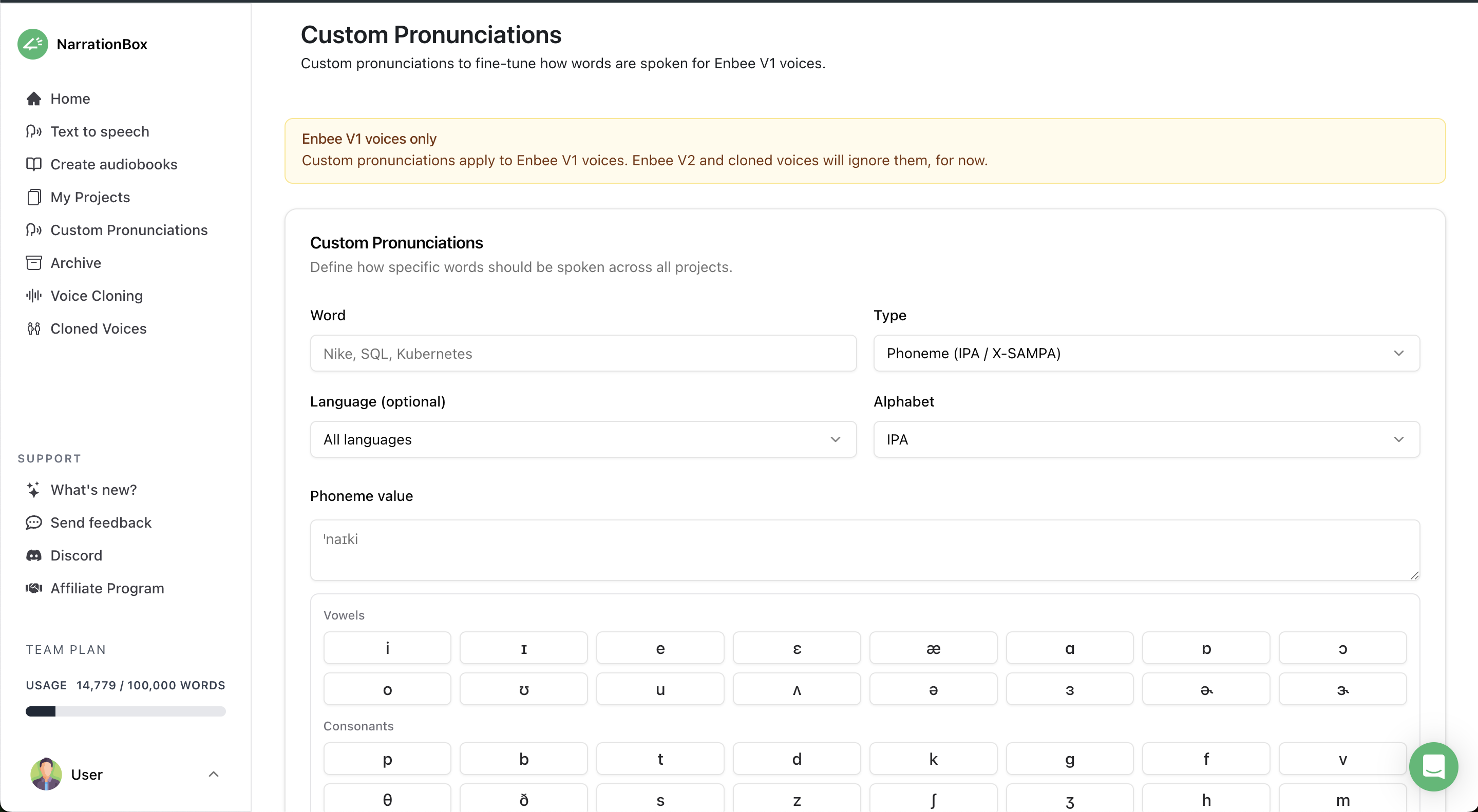
This matters because:
- Fantasy and sci fi authors maintain name consistency across series
- Non fiction authors ensure technical terms are spoken correctly
- Retakes for mispronounced words drop close to zero
From a cost perspective, this removes one of the most expensive post production loops in traditional narration.
Using AI Audiobooks to Fund Growth Rather Than Delay It
Lower production cost changes how authors allocate money, not just how much they spend.
Common reinvestment paths include:
- Producing ARC audio copies earlier to seed reviews
- Testing shorter audio editions before committing to full length releases
- Launching multilingual audiobooks to validate international demand
- Accelerating series releases to maintain listener momentum
Instead of waiting months to recoup narration costs, authors can release, measure, and adapt within weeks.
This is particularly relevant for nonfiction authors using audiobooks for authority building rather than direct royalties.
Practical Workflow for Authors Using AI Audiobooks
A realistic workflow looks like this:
- Validate audiobook demand using AI narration for the first release
- Gather listener feedback on pacing, voice fit, and engagement
- Refine style prompts and pronunciation rules
- Expand into sequels, translations, or companion audio formats
The critical shift is psychological. Audio becomes iterative rather than final. That alone reduces risk.
Making Your AI Audiobook Engaging and Bestselling
Technical quality matters, but listener engagement determines whether your audiobook succeeds. These elements drive performance:
Strong Opening Hook
The first 3 minutes determine whether listeners commit or refund. Use style prompting to ensure your opening delivers energy and intrigue.
Prompt your Enbee V2 voice to "Speak with confidence and mystery" or "Deliver this with warmth and immediate tension" depending on your genre.
Test your opening with beta listeners specifically. Ask them if they'd keep listening based solely on the first chapter. If feedback is lukewarm, adjust your opening's emotional delivery and test again.
Consistent Character Voices
If you're narrating fiction with multiple POV characters, use style prompts to differentiate their narrative voices. Prompt Chapter 1 (from Character A's POV) to "Speak with a contemplative, measured tone." Prompt Chapter 2 (from Character B's POV) to "Deliver this with energy and impatience."
The AI won't create distinct vocal timbres for each character the way a professional narrator voices different roles, but tonal differentiation helps listeners track POV shifts.
Strategic Pacing
Action sequences benefit from faster pacing and higher energy. Emotional scenes need space and slower delivery. Review your manuscript for pacing shifts and use style prompts to guide the AI.
For action: "Speak quickly with urgency and intensity." For reflection: "Slow the pace and use a thoughtful, introspective tone." For dialogue-heavy scenes: "Keep energy up and vary rhythm to match conversation flow."
Chapter-End Hooks
Cliffhangers drive binge-listening. If your chapters end on hooks, use emotion tags to emphasize the tension. Insert [serious] or [ominous] before your final line to make the hook land harder.
Test chapter endings with beta listeners. Ask them if they felt compelled to continue to the next chapter. If retention drops between chapters, strengthen your hooks and adjust emotional delivery.
Series Optimization
If you're producing a series, maintain narrator consistency across all books. Listeners bond with specific voices. Switching from Ivy to Lorraine between Book 1 and Book 2 disrupts immersion and can hurt Book 2's performance.
Use the same style prompts and emotion tags across the series to maintain tonal consistency. If Book 1's opening was "Speak with energy and intrigue," use the same prompt for Book 2's opening.
Advanced Tactics for Monetizing AI Audiobooks
Beyond standard retail distribution, these strategies maximize revenue from your AI-produced audiobooks.
Patreon Exclusive Releases
Offer early access to your audiobook on Patreon before wide release. Supporters at a $15 per month tier get the audiobook 30 days before it hits Audible. This creates urgency and converts dedicated readers into recurring revenue.
Since AI production costs $99 monthly, you only need 7 Patreon supporters to cover costs. Everything beyond that is profit before your book even launches publicly.
Bundled Direct Sales
Sell ebook + audiobook bundles directly through platforms like BookFunnel or Payhip. Price the bundle at $19.99 when the ebook alone costs $4.99 and the audiobook retails for $14.95. The perceived value drives conversions, and you keep 85% to 95% of revenue instead of the 25% to 40% you'd earn through traditional retail.
Direct sales work particularly well for romance and fantasy authors with engaged audiences. Promote bundles to your email list and in your reader group.
Kickstarter Campaigns
Launch a Kickstarter to fund audiobook production for your backlist series. Offer the completed audiobooks as rewards. Backers pledge $25 to $50 to receive the full series in audio format.
Your actual production cost is $99 for the month it takes to generate all the audiobooks. A campaign that raises $2,000 from 50 backers leaves you with $1,900 in profit while simultaneously building an engaged audience for future releases.
Wholesale Licensing
License your audiobooks to libraries and educational institutions through platforms like Hoopla, OverDrive, and Bibliotheca. Libraries pay per checkout, and while individual payments are small ($1 to $3 per checkout), volume adds up.
A single audiobook licensed to 500 libraries can generate $2,000 to $5,000 annually in passive income through checkout fees. With AI production keeping costs near zero, this becomes pure profit.
International Expansion as Core Strategy
Don't treat international markets as an afterthought. Translate your book into 5 to 8 languages and produce audiobooks for each using the same Enbee V2 voice. Your total cost: $12,000 to $24,000 in translation fees plus your $99 monthly Narration Box subscription.
Distribute all language versions simultaneously. A reader in France discovers your thriller, buys the French audiobook, and you've entered a market you couldn't afford to test with traditional production.
Languages to prioritize based on audiobook market size: Spanish, German, French, Italian, Portuguese, Japanese, and Mandarin.
Frequently Asked Questions
Can I use AI to make an audiobook?
Yes. AI narration is increasingly accepted by listeners when emotional delivery and pronunciation are handled carefully.
Does AI reduce cost?
AI reduces upfront production cost significantly, especially narration and retakes, while keeping editorial control intact.
How much does audiobook production cost?
Traditional production often ranges from USD 3000 to 7000 for a mid length book. AI based workflows can reduce this by a large margin depending on scope.
Does Audible accept AI generated books?
Policies evolve. Acceptance depends on platform rules and disclosure requirements. Many authors use AI for testing and wide distribution.
How to create an audiobook with AI?
Upload your manuscript, select a narrator, guide delivery with prompts, and export audio using an audiobook focused platform.
How to convert ebooks to audiobooks
Modern tools accept EPUB, PDF, and Word formats directly and handle chapter segmentation automatically.
How can I turn my book into an audiobook through Amazon?
Amazon audiobooks typically flow through ACX. Production method matters less than meeting quality and policy standards.
How to make an audiobook for free?
Free tiers allow testing but full releases usually require paid plans due to word limits.
Does Amazon KDP do audiobooks?
KDP focuses on ebooks and print. Audiobooks are handled separately.
Why is Amazon shutting down KDP accounts?
Account actions are usually tied to policy violations, content quality, or rights issues rather than audiobook format alone.
What is the 10 percent rule for KDP?
It refers to preview limits for ebooks, not audiobooks.
Closing Thought
Audiobooks no longer need to be the last format an author considers. With the right AI tools, they can be the first signal of reader demand.
If you are evaluating AI narration seriously, the audiobook specific workflow from Narration Box is designed for authors who want control, speed, and realistic delivery without committing capital prematurely.
You can explore it directly and decide where it fits in your publishing strategy.
